
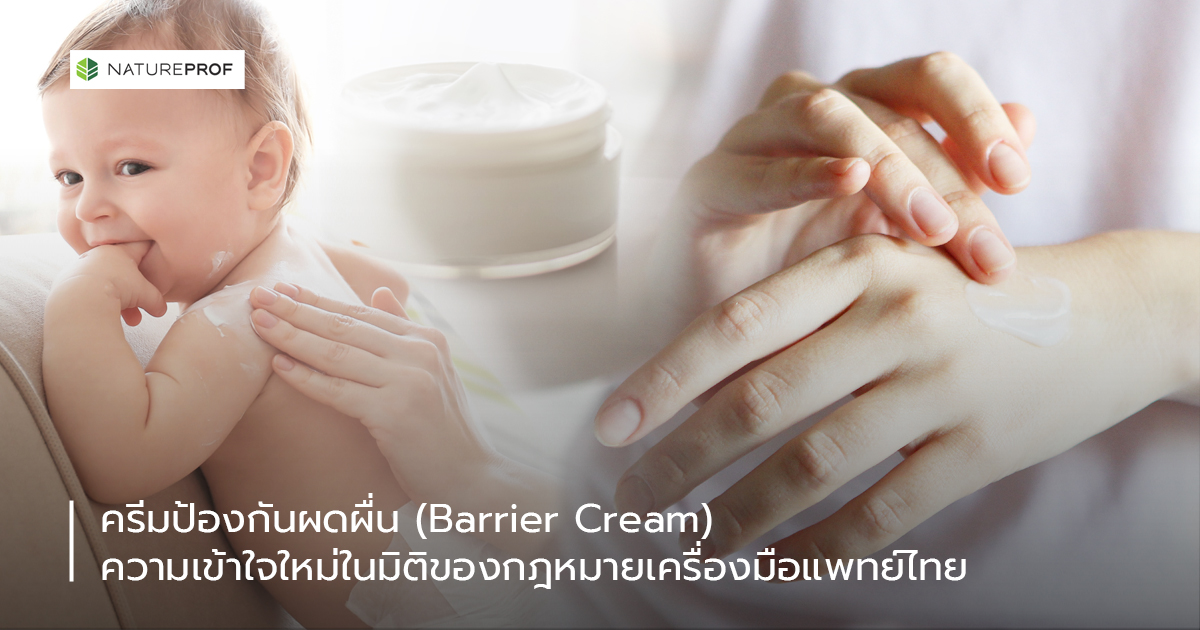
Why rash-prevention cream is not just a “moisturizing cream”
In Thailand’s health and beauty market, we find many products marketed as rash-relief cream, anti-rash cream, or skin-coating cream. Most of them are sold as cosmetics, because consumers are more familiar with the term “moisturizing cream”.
However, in reality, a rash-prevention cream that works through a physical mechanism to protect the skin from irritation – such as friction or contact with fluids – may fall under the category of “medical device” according to the Thai Medical Device Act.

Image name : Barrier Cream for Rash Prevention : A New Perspective in the Context of Thai Medical Device Law
Correct product classification not only helps brands avoid legal violations, but also builds “credibility and long-term business value”. This is something that NatureProf prioritizes in every step of OEM/ODM product development for clients in the health and beauty industry.
Understanding the basics of Thai medical device law
(Medical Device Act, Medical Device Act B.E. 2551 (2008) and its amendment B.E. 2562 (2019))
Thailand’s Medical Device Act is regulated by the Food and Drug Administration (Thai FDA), which defines a “medical device” as any article used for the diagnosis, prevention, treatment, relief, or cure of diseases in humans, that does not exert its primary intended action on or in the human body by pharmacological, immunological, or metabolic means.
In other words, if a product does not penetrate the body to act through a chemical mechanism, but works via a physical mechanism – such as coating, protecting, separating irritants, or reducing friction – it may fall within the scope of a “medical device”.
A rash-prevention cream that acts through a physical mechanism therefore has a different regulatory status from a regular cream. It does not primarily aim to “treat” existing rashes, but rather to “prevent” skin irritation from occurring – similar in principle to skin-protective medical devices used in clinical care (Skin Protective Medical Devices).
The difference between cosmetics, drugs, and medical devices
To clearly understand which category a rash-prevention cream belongs to, we can look at the differences between these three categories under Thai law:
|
Product Type |
Main Purpose |
Mechanism of Action |
Regulatory Authority (Thailand) |
Examples |
|
Drug |
Treating, curing, or relieving disease |
Chemical/biological action |
Drug Control Division, Thai FDA |
Steroid cream, calamine lotion |
|
Cosmetic |
Nourishing, covering, enhancing appearance |
No therapeutic/medical effect |
Cosmetics Control Division, Thai FDA |
Moisturizing cream, body lotion, hydrating lotion |
|
Medical Device |
Protecting / shielding the body |
Physical mechanism |
Medical Device Control Division, Thai FDA |
Rash-prevention coating cream, skin-protective film |
Therefore, if a rash-relief cream is used to:
● “Prevent” irritation by a physical mechanism – for example, coating the skin, protecting against body excretions, or reducing friction from diapers – it will be classified as a “low-risk medical device (Class 1)” under the Thai FDA’s risk classification system.
Classification and registration of medical devices
Medical devices in Thailand are divided into four risk classes (Class 1–4):
● Class 1 (low risk) → e.g., rash-prevention cream, wound dressings, surgical masks
● Class 2 (low to medium risk) → e.g., blood pressure monitors, simple respiratory devices
● Class 3–4 (high risk) → e.g., cardiac pacemakers, surgical instruments, implantable devices
A rash-prevention cream with the characteristics of a “barrier cream” will be classified as Class 1, which is the group with the simplest registration pathway. However, it still requires a formal process of “Medical Device Listing” with the Thai FDA before marketing.
Key documents required include, for example:
● Product specifications (Product Specification)
● Instructions for use and intended purpose (Intended Use)
● Label and Instructions for Use (IFU) (Label & IFU)
● Evidence of manufacturing quality standards (such as ISO 13485 or GMP for medical devices)
Once the submission has been reviewed and approved, the Thai FDA issues a Medical Device Listing certificate, which is valid for 5 years and can be renewed.

Image name : Barrier Cream for Rash Prevention : A New Perspective in the Context of Thai Medical Device Law
Standards related to barrier creams in the global market
Barrier creams used in medical settings (Medical Barrier Creams) in other countries, such as the United States and the European Union, are also classified as Class I Medical Devices (Low Risk), similar to Thailand. They reference international standards such as:
● ISO 13485 : Quality Management System for Medical Devices
● ISO 10993 : Biological Evaluation of Medical Devices
● ASEAN CSDT (Common Submission Dossier Template) for registration dossiers
If Thai brands develop barrier creams in compliance with these standards, they can expand into ASEAN member countries and European markets in a correct and efficient manner, as Thailand’s regulatory system has been aligned with the ASEAN Medical Device Directive (AMDD).
Business opportunity : the health-oriented skincare market
The market for rash-prevention creams is no longer limited to infants. There is a growing trend in:
● Adults with sensitive skin
● Elderly people who need targeted skin care
● Bedridden patients
● Hospitals and clinics that use such products in patient care
Data from Euromonitor indicates that the market for cosmeceuticals and specialized skincare in Thailand has been growing at an average of 7–8% per year, with “medical skincare” being one of the fastest-growing segments.
Investors and brand owners who understand the “legal dimension of medical devices” therefore have a clear opportunity to differentiate themselves from competitors.
NatureProf specializes in developing rash-prevention barrier cream formulas under manufacturing standards suitable for medical devices, and can fully support the preparation of technical documentation required for Thai FDA registration – from formula development and safety testing to the preparation of COA (Certificate of Analysis) and TDS (Technical Data Sheet) according to international standards.
Legally compliant communication and advertising
Products classified as medical devices must obtain an Advertising License from the Thai FDA before any advertisement is published. Advertising content must not claim to “treat disease” or “reduce inflammation”, but may use wording that reflects “prevention” or “protection of the skin from irritation”, for example:

Image name : Barrier Cream for Rash Prevention : A New Perspective in the Context of Thai Medical Device Law
● Protective cream that shields the skin from moisture and friction, suitable for sensitive skin.”
● “Helps create a thin protective film over the skin to prevent irritation-induced rashes.”
NatureProf helps clients develop communication content that aligns with Thai FDA guidelines, so that products can enter the market correctly and safely – for both brands and end-users.
“Understand it correctly to build sustainable differentiation”
A rash-prevention cream that works via a physical mechanism is not just an ordinary “moisturizing cream”. It is an innovation in skin protection technology that is recognized at the international level and falls under the regulatory framework of Thailand’s medical device law.
Proper development and registration from the very beginning not only reduces legal risk, but also enhances credibility, safety, and readiness for expansion into international markets in a truly professional manner.
If you are a brand owner or investor who wants to create a barrier cream that complies with legal requirements – and you need a development team that understands both science and regulation – NatureProf can support you.
Contact the NatureProf team (OEM / ODM factory) today to receive complimentary consultation on the development of medical-device-type creams and gels for skin.