
Growth of the Mother and Baby Market: From Essential Goods to a Multi-Billion Market
Over the past decade, the mother and baby products market has become one of the most steadily growing industries in Asia, especially in Thailand and the ASEAN region. Even though birth rates are declining, the behavior of new-generation parents has changed significantly. They choose “quality over quantity” and are willing to pay for safety, gentleness, and convenience in taking care of their children.

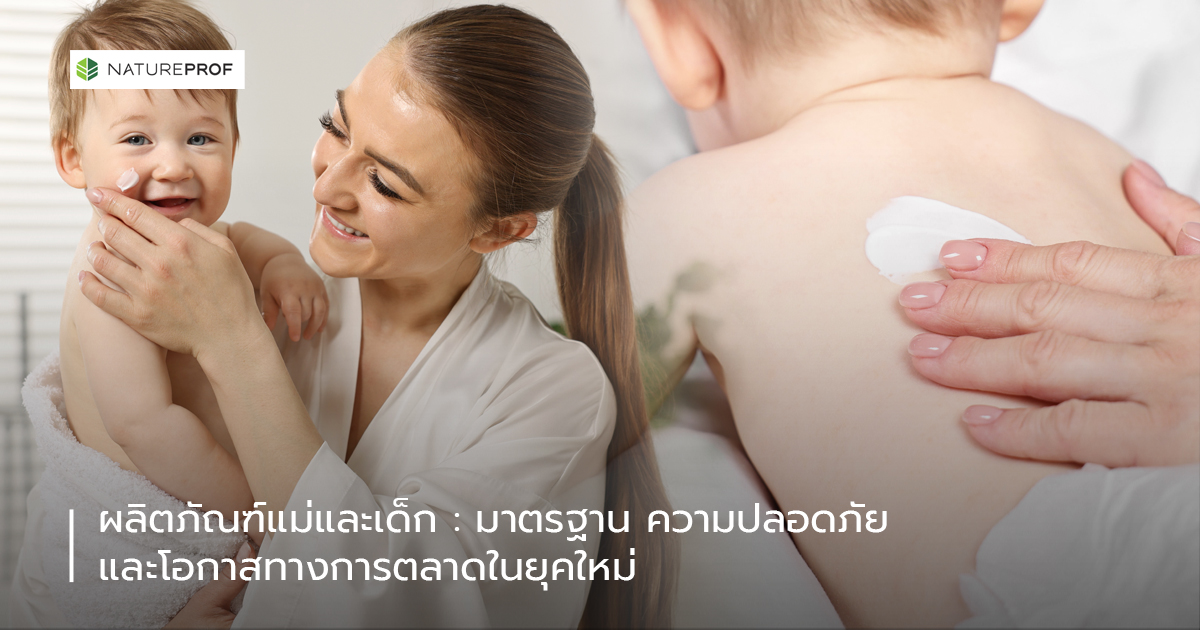
Image name : Mother and Baby Products: Standards, Safety, and Market Opportunities in the New Era
According to data from Euromonitor, the mother and baby products market in the Asia–Pacific region was valued at more than USD 30 billion in 2023, with an average annual growth rate of over 8%. In Thailand alone, the market value exceeds 40 billion baht, covering baby food, baby care equipment, cosmetics for mothers, and home medical devices. This is a clear sign that this product category remains “investable” and is open to new entrants.
Categories of Mother and Baby Products
Mother and baby products can be divided into four main groups:
- Baby Equipment
Such as baby bottles, strollers, baby cribs, car seats, booster seats, baby carriers, and everyday items for infants and young children. - Skin and Personal Care Products
Such as baby skin care creams, diaper rash creams, baby shampoo, baby sunscreen, as well as skin care products for postpartum mothers. - Baby Food and Infant Formula
Covering various types of infant formula, pureed baby food, baby snacks, and organic products designed to provide age-appropriate nutrition at each developmental stage. - Medical Devices for Mother and Baby
Such as breast pumps, thermometers, devices for measuring body temperature or oxygen saturation, and home-use health monitoring devices.
Each category is governed by different regulatory frameworks and safety standards, which brand owners and investors should thoroughly understand before developing and launching products to market.
1. Baby Equipment : Safety as the Core Priority
Laws and Standards in Thailand
Baby equipment such as car seats, strollers, or baby cribs are regulated by the Thai Industrial Standards Institute (TISI) under the Ministry of Industry. There are specific Thai Industrial Standards (TIS), for example:
● TIS 3418-2565 for car seats
● TIS 969-2533 for rubber teats on baby bottles
These standards help ensure that products pass tests related to pressure, load-bearing capacity, and durability.
Another important law is the Land Traffic Act (No. 13), B.E. 2565, which mandates that children under 6 years of age must sit in a car seat and wear a seat belt. Non-compliance may result in a fine of up to 2,000 baht. This law has driven a rapid increase in the demand for car seats among Thai parents.
Market Trends and Business Opportunities
New-generation parents are increasingly focused on materials that are safe for babies’ skin, such as BPA-free plastics and recyclable materials. There is also growing demand for smart baby gear that connects with mobile applications, such as Wi-Fi baby monitors, smart bottle warmers, or devices for tracking infant sleep. As a result, many startups are investing in “mother and baby technologies”, which presents a golden opportunity for entrepreneurs with innovation capabilities.
Market-leading brands include Graco, Chicco, Combi, Joie, and Thai brands such as BonnyKids and Punnita, which have started developing equipment made from natural materials and designs tailored to Thailand’s climate.
2. Skin and Personal Care Products : Gentleness That Must Be Proven
Relevant Laws
Skin care products for mothers and babies fall under the Cosmetics Act B.E. 2558 (2015), which requires manufacturers and importers to notify product details to the Food and Drug Administration (FDA), Thailand before marketing. Key information such as ingredients, concentration, and quantity must be clearly declared.
In addition, the Thai FDA has issued notifications prohibiting the use of certain substances. For example, Silver chloride must not exceed 0.004% and is prohibited in products for children under 3 years of age to prevent irritation and the risks associated with heavy metals.
Manufacturing and Testing Standards
Today, factories producing products for babies must comply with GMP (Good Manufacturing Practice) standards. They should also obtain results from Non-Irritation Tests or HRIPT (Human Repeat Insult Patch Test) to confirm safety for baby skin and pregnant mothers. These are services that NatureProf can provide comprehensively, from testing through to issuing internationally recognized reports.
Market Trends in Thailand and ASEAN
The Natural & Organic Baby Care segment is expanding rapidly, with an average annual growth rate of more than 10%. Consumers are increasingly attentive to safe ingredients such as natural oils, shea butter, aloe vera, and oat extract.
Popular brands in the Thai market include Johnson’s Baby, Sebamed, Mustela, Cussons Baby, Mama’s Choice, as well as Thai brands such as Smooth E Baby and Baby Natura, which are beginning to penetrate the herbal baby product segment.
3. Baby Food and Infant Formula : A Business That Requires Both Quality and Responsibility
Marketing and Production Regulations
Infant formula and baby food are regulated under the Food Act B.E. 2522 and the Act on the Control of Marketing of Infant and Young Child Food B.E. 2560. These laws prohibit advertising infant formula or baby foods in a way that solicits purchase or devalues breastfeeding.
Manufacturers must apply for FDA registration numbers and undergo nutritional assessments, including requirements for protein, vitamins, and minerals as specified by the Ministry of Public Health.
Market Trends in Thailand and ASEAN
The baby food and infant formula market in Thailand is valued at more than 40 billion baht, with particularly intense competition in infant formula among global brands such as:
● Nestlé (Lactogen, NAN)
● Danone (Dumex, Friso)
● Abbott (Similac)
● Mead Johnson (Enfamil, Dugro)
In ASEAN, Indonesia and the Philippines are the largest markets, with a combined value of more than USD 3.7 billion, and expected growth of 9–10% annually. Key drivers include the rising number of working mothers returning to the workforce after childbirth, demand for high-quality ready-to-eat products, and the strong trend toward organic baby food in the premium market.
Opportunities for Thai Entrepreneurs
Although this market is heavily dominated by multinational brands, opportunities still exist for Thai manufacturers—particularly in developing baby dietary supplements from local ingredients, such as germinated brown rice, organic soy, or nutrient-rich Thai fruits. These can be elevated into “functional baby food”, adding substantial value.
4. Medical Devices and Supplies : A Small but Fast-Growing Market
Laws and Standards
This product group is regulated under the Medical Device Act B.E. 2551 (2008). The Food and Drug Administration (FDA), Thailand requires all products such as breast pumps, thermometers, and child health monitoring devices to obtain import or registration approval before sale.
Internationally, key standards include ISO 13485 for medical device quality management systems and CE Mark / FDA (U.S.) requirements for export or sales in overseas markets.
Market Trends
The breast pump market in Asia–Pacific is projected to reach USD 438 million in 2024, with an average annual growth rate of 10%. Growth is driven by working mothers returning to the workforce and the demand for portable technologies, such as wireless breast pumps and digital thermometers that connect to smartphones.
Popular brands in this category include Medela (Switzerland), Spectra (South Korea), Philips Avent (Netherlands), Unimom, and Omron for health monitoring devices.

Image name : Mother and Baby Products: Standards, Safety, and Market Opportunities in the New Era
Strategic Perspective: Why Entrepreneurs Must Prioritize “Standards”
1. Safety Is the Core Selling Point
The mother and baby market is one of the most scrutinized segments by consumers. Quality certifications and test results from trusted laboratories such as VISBIO or NatureProf are therefore crucial in building strong brand-level trust.
2. Regulations Are Tightening Every Year
In both Thailand and ASEAN, government agencies continue to raise standards for mother and baby products—for example, stricter controls on prohibited substances in baby cosmetics and tighter advertising rules for baby food. Entrepreneurs must continually update their knowledge of relevant laws and prepare supporting documentation from the outset.
3. Consumers Are Willing to Pay for Products That Are “Scientifically Proven”
Brands that can present safety test results (such as Non-Irritation, Hypoallergenic, or Heavy Metal Tests) and quality certifications that comply with ISO/GMP standards gain significantly higher consumer confidence than ordinary brands.

Image name : Mother and Baby Products: Standards, Safety, and Market Opportunities in the New Era
The Role of NatureProf in Elevating Mother and Baby Product Standards
NatureProf is a company that provides comprehensive research, development, and testing services for health and beauty products. It operates international-standard testing laboratories covering active ingredient analysis, safety testing, and preparation of documents for product registration.
Key services related to the mother and baby sector include:
● Safety and efficacy testing of products (Safety & Efficacy Tests)
● Testing for heavy metals and microorganisms (Heavy Metals & Microbial Tests)
● Non-Irritation Tests and HRIPT
● Preparation of supporting documents such as MSDS, Specification Sheets, COA, TDS
● Consultancy on marketing regulations and product registration with the Thai FDA
NatureProf is not just an analytical laboratory, but also acts as a technical consultant for brand owners seeking to develop mother and baby products that meet international standards—from concept formulation through to strategic market planning.
Mother and Baby Market : An Opportunity That Must Come with Responsibility
The mother and baby products market is not only a “revenue-generating business” but also a “trust-building business.” Understanding laws, standards, and consumer expectations is essential to long-term survival in this market.
For entrepreneurs seeking to develop mother and baby products—whether baby skin care creams, lotions for pregnant women, infant formula, or medical devices—the first step toward success is to begin with testing and quality certification by experts. NatureProf (OEM / ODM factory) is ready to be a trusted partner at every step of the development journey.